

Iraq is renowned as the “cradle of civilization” having hosted some of the world’s earliest human societies. The Sumerians, emerging around 6,000 BC as the first urban civilization, invented cuneiform writing and established pioneering city-states such as Uruk and Ur. This was followed by the Akkadian Empire, founded by Sargon the Great in 2334 BC, which is recognized as history’s first known empire. Later, the Babylonian Empire rose to prominence, reaching its zenith under the rule of Hammurabi.
Subsequently, the Assyrian Empire became one of antiquity’s most formidable powers, famed for its military prowess and vast capital cities like Nineveh. A resurgence of Babylonian culture occurred under the Neo-Babylonian Empire, most notably under Nebuchadnezzar II, who oversaw the flourishing of its capital and the legendary Hanging Gardens.
A pivotal shift occurred with the arrival of Islam in the 7th century, leading to Iraq’s incorporation into the Umayyad and later the Abbasid Caliphates. The Abbasids founded Baghdad in 762 AD, which evolved into a globally renowned center of scholarship, culture, and philosophy, epitomized by its famous House of Wisdom. This golden age was brutally interrupted in 1258 when the city was sacked by Hulagu Khan, an event that destroyed the Abbasid Caliphate and inflicted widespread devastation. After a period of instability, Iraq was absorbed into the Ottoman Empire in the 16th century, remaining under its rule until the end of World War I.
Following the war, control of Iraq passed from the Ottomans to Britain. The League of Nations granted Britain a mandate over Iraq in 1920. The country later became a kingdom under King Faisal I, achieving formal independence in 1932. The monarchy was overthrown in a 1958 military coup, which established the Republic of Iraq.
Iraq, with its capital in Baghdad, is divided into 19 governorates and has an estimated population of about 46 million people as of 2024. According to official data from the World Bank, the country’s Gross Domestic Product (GDP) was valued at approximately 279.64 billion U.S. dollars in 2024. This reflects Iraq’s position as one of the major economies in the Middle East, supported largely by its oil sector, while also highlighting ongoing efforts to diversify its economy and promote development across its various regions.
Erbil, also spelt Arbil (Kurdish: ھەولێر / Hewlêr), locally called Hawler by the Kurds, is the capital city of Iraqi Kurdistan and the most populated city in the Kurdish inhabited areas. It is located approximately in the center of Iraqi Kurdistan region and north of Iraq. It has about 850,000 inhabitants, and Erbil governorate has a permanent population of 2,009,367 as of 2015.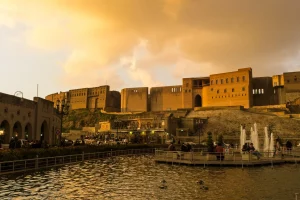 Human settlement at Erbil can be dated back to possibly 5th millennium BC, and it is one of the oldest continuously inhabited areas in the world. At the heart of the city is the ancient Citadel of Erbil. The earliest historical reference to the region dates to the Third Dynasty of Ur of Sumer, when King Shulgi mentioned the city of Urbilum. The city was later conquered by the Assyrians.
Erbil became an integral part of the kingdom of Assyria by at least the 21st century BC through to the end of the seventh century BC, after it was captured by the Gutians, and it was known in Assyrian annals variously as Urbilim, Arbela and Arba-ilu. After this it was part of the geopolitical province of Assyria under several empires in turn, including the Median Empire, the Achaemenid Empire (Achaemenid Assyria), Macedonian Empire, Seleucid Empire, Parthian Empire, Roman Assyria and Sasanian Empire (Asōristān), as well as being the capital of the tributary state of Adiabene between the mid-second century BC and early second century AD.
Erbil’s archaeological museum houses a large collection of pre-Islamic artefacts, particularly the art of Mesopotamia, and is a center for archaeological projects in the area. The city was designated as Arab Tourism Capital 2014 by the Arab Council of Tourism. In July 2014, the Citadel of Arbil was inscribed as a World Heritage site.
The city has an ethnically diverse population of Kurds (the majority ethnic group), Armenians, Assyrians, Arabs, Iraqi Turkmens, Yezidis, Shabakis and Mandaeans. It is equally religiously diverse, with believers of Sunni Islam, Shia Islam, Christianity (mainly followed by Assyrians and Armenians), Yezidism, Yarsanism, Shabakism and Mandaeism extant in and around Erbil.
The Official Language
The official language in Erbil is Kurdish. The second language is Arabic, while the third language is English and is spoken by almost all people. The official language of the SHAPE2025 conference is English.
Hosting University:
Tishk International University
Tishk International University (TIU), established in 2008 in Erbil, Kurdistan Region – Iraq, is one of the leading private universities in the region, dedicated to excellence in education, research, and community engagement. The university offers a comprehensive range of undergraduate and postgraduate programs across multiple fields including engineering, business and management, education, law, pharmacy, dentistry, and applied sciences.
TIU is officially recognized by the Ministry of Higher Education and Scientific Research of the Kurdistan Regional Government (KRG), the federal Ministry of Higher Education and Scientific Research as well as by the Ministry of Higher Education and Scientific Research in Jordan and the Ministry of Higher Education in the United Arab Emirates. In addition, several of TIU’s academic programs have obtained international accreditation from prominent European quality assurance agencies, such as ZEvA– Germany, ASIIN-Germany, and AQAS– Germany.
These accreditations demonstrate TIU’s steadfast commitment to international academic standards, transparency, and institutional excellence. Through active collaborations with prestigious universities and organizations worldwide, TIU continues to strengthen its global engagement and contribute meaningfully to the advancement of higher education in the Kurdistan Region, Iraq, and beyond.
Touristic Places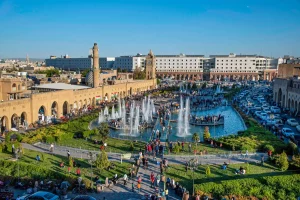 The Citadel of Arbil is a tell or occupied mound in the historical heart of Erbil, rising between 25 and 32 metres (82 and 105 ft) from the surrounding plain. The buildings on top of the tell stretch over a roughly oval area of 430 by 340 metres (1,410 ft × 1,120 ft) occupying 102,000 square metres (1,100,000 sq ft). It has been claimed that the site is the oldest continuously inhabited town in the world. The earliest evidence for occupation of the citadel mound dates to the 5th millennium BC and possibly earlier.
During the 20th century, the urban structure was significantly modified, as a result of which a number of houses and public buildings were destroyed. In 2007, the High Commission for Erbil Citadel Revitalization (HCECR) was established to oversee the restoration of the citadel.
Other sights
- Museums and Heritage Sites
Erbil Citadel: The heart of the city’s history. The citadel hosts museums restore traditional houses, ancient architecture, and offer panoramic views of Erbil.
Erbil Stones and Gems Museum: Located within the Citadel; showcases gemstones, fossils, meteorites and rare stone artifacts.
Syriac Heritage Museum: In the Ankawa district, preserving and displaying Syriac Christian heritage, manuscripts, and cultural history of the Syriac community.
Turkmen Culture House: An exhibition house in the Citadel displaying artifacts, traditional interiors, and components that reflect the Iraqi Turkmen culture.
Kurdistan Music Archive: Located in the Citadel; it preserves Kurdish musical heritage through old recordings, phonographs, and archives.
- Markets, Bazaars & Shopping
Qaysari Bazaar (Erbil Bazaar): A vibrant, traditional bazaar near the Citadel. It is ideal for exploring local crafts, textiles, spices, jewelry, handicrafts, sweets and more, in narrow alleys. Excellent for cultural immersion.
Other modern malls & shopping centers also exist, offering a mix of international and local retail, dining, cafés, cinemas. Useful for a more leisure-based social outing.
- Parks & Outdoor Spaces
Sami Abdulrahman Park: One of the largest public parks in Erbil. Features lakes, walking paths, gardens, playgrounds. A preferred place for picnics, exercise, social gatherings, family outings.
Nature trips: Mountains near Erbil (e.g. Korek Mountain), waterfalls (Bekhal), scenic landscapes for hiking, day-trips. These provide outdoor adventure or relaxation outside city traffic.
- Religious & Architectural Landmarks
Jalil Khayat Mosque: A modern mosque with impressive architecture (combined styles of Abbasid and Ottoman influences). A place of cultural interest; visitors often appreciate its design and scale.
Minaret Park / Choli Minaret: Mudhafaria Minaret, a historic 12th-century structure. The park around it is pleasant for walks or quiet reflection.
- Festivals, Events & Cultural Life
Erbil International Book Fair: Annual literary event attracting local and international authors, publishers, cultural discussion.
Mosul Tells Cultural Festival: An example of a recent cultural festival involving exhibitions, art and heritage displays.
University cultural centers often host poetry nights, art exhibitions, lectures, concerts. Active academic social life.
- Entertainment & Leisure Parks
Majidi Land: A family amusement park with rides, games, a play area for children, and other leisure attractions. A popular venue for families and young people.
Cafés, restaurants, and tea houses: Widespread across Erbil. Good for socializing, meeting friends, dining local or international cuisine. Areas like Ankawa are known to have more cafés and restaurants oriented for more casual social life.
- Nightlife & Social Venues
While the nightlife in Erbil is more moderate compared to some global cities, there are social venues, lounges, bars (especially in Ankawa), rooftop cafés, restaurants with music, and occasional evening events. These offer opportunities for social interaction, relaxation, and entertainment.
Brief on the Currency Exchange Rate
Current Status (as of 2024-2025): The exchange rate for the Iraqi Dinar (IQD) in Erbil, and across the Kurdistan Region is a critical and volatile economic issue, heavily influenced by federal policies in Baghdad.
Official Rate: The official rate set by the Central Bank of Iraq (CBI) is approximately 1,310 IQD to 1 US Dollar (USD). This rate is typically used for government transactions, imports of essential goods (like food and medicine), and by select private banks.
Parallel (Market) Rate: The rate used in everyday cash transactions in Erbil’s local money exchanges (Sarraf) is significantly weaker, fluctuating between 1,410 to 1,450 IQD to 1 USD. This is the rate that most directly affects the local economy and the public.
Official page of Erbil Governorate: http://hawlergov.org/app/en
A short promo video about Erbil City (Credit: Kurdistan Regional Government)